Cummins fault codes tell you exactly which system is failing and how it's failing — but only if you know how to read them. This guide goes beyond a simple code list. For every major code you'll find the plain-English meaning, common causes, symptoms, diagnostic steps, typical repair, and whether the machine is safe to operate. Whether you're a technician in the shop, a fleet manager on the road, or an equipment owner seeing a check engine light, this is the resource you need.
What Is a Cummins Fault Code?
A Cummins fault code is a diagnostic trouble code (DTC) generated by the Engine Control Module (ECM) when it detects a sensor reading, circuit value, or system parameter outside its acceptable range. Codes are structured as an SPN (Suspect Parameter Number, identifying the component) paired with an FMI (Failure Mode Identifier, describing how it's failing). On newer engines you'll also see OEM-specific codes that add further diagnostic detail beyond the J1939 standard.
Table of Contents
How to Check Cummins Fault Codes
The best way to check Cummins fault codes is with a diagnostic scanner. We often recommend Jaltest to our clients using Cummins.
Jaltest has expert technicians developing comprehensive, up-to-date coverage of Cummins systems, with 3 software updates per year free of charge.
For shops servicing Cummins engines, Jaltest offers:
Comprehensive Cummins Coverage: Developed by dedicated diagnostic engineers, Jaltest provides extensive coverage across Cummins engine systems, including aftertreatment, fuel systems, emissions, and electronic control modules.
Step-by-Step Troubleshooting: Jaltest provides guided troubleshooting procedures, wiring diagrams, technical data, and repair instructions, going far beyond fault code reading and helping technicians resolve vehicle issues faster.
Live Data & System Monitoring: Jaltest monitors real-time engine parameters, sensor values, and system performance to diagnose intermittent or complex issues early-on.
Bi-Directional Controls & Calibrations: With Jaltest, techs can single-handedly perform forced regens, component activations, injector coding, DPF resets, and other advanced OEM-level service functions with the click of a button.
Predictive Maintenance Capabilities: Predictive maintenance is better than reactive maintenance because it allows you to identify developing issues before they become costly breakdowns. Jaltest’s intuitive platform encourages predictive maintenance best practices to reduce downtime.
What to record when pulling codes: SPN number, FMI number, OEM/Cummins code (if available), active or inactive status, occurrence count and most recent timestamp, and any freeze-frame data (engine conditions at the moment of fault).
Technician Tip: Always record all codes before clearing anything. On aftertreatment faults especially, multiple codes often share a single root cause. Clearing codes before documenting them means you lose the sequence, which makes finding the root cause even harder.
Cummins Models Covered by Jaltest in 2026
These are just some of the Cummins CV models covered by Jaltest Diagnostics:
6.7N
B SERIES
B5.9G
BES EV
C8.3G
CELECT
D SERIES
F SERIES
GAS PLUS
ISB
ISC
ISD
ISF
ISG
ISL
ISM
ISV
ISX
ISZ
L SERIES
M SERIES
QSB
R SERIES
X SERIES
Z SERIES
Understanding SPN vs. FMI vs. OEM Codes in Cummins 2026 Models
With all the acronyms involved, it may get a little confusing. When diagnosing fault codes on newer Cummins engines, especially 2026 emissions-compliant models, it’s important to understand the difference between SPN, FMI, and OEM-specific codes.
What Is an SPN Code
SPN stands for Suspect Parameter Number. It can help you understand what specific system or component is reporting a problem.
SPNs are standardized and consistent across manufacturers.
Example:
SPN 102 = Intake Manifold Pressure
SPN 3216 = Aftertreatment 1 Outlet NOx Sensor
What Is an FMI Code
FMI stands for Failure Mode Identifier and describes how that component (SPN) is failing. It basically answers the question of “what’s wrong?”
FMI codes are paired with SPNs to describe the type of fault detected.
Common FMI examples:
FMI 0 = Data valid but above normal operating range
FMI 1 = Data valid but below normal operating range
FMI 3 = Voltage above normal
FMI 4 = Voltage below normal
FMI 9 = Abnormal update rate
What Are OEM Codes in Cummins?
In addition to SPN/FMI codes, Cummins engines will generate OEM-specific fault codes. These codes are not meant to be easily-accessible unless you have an OEM-level tool like Jaltest.
These are manufacturer-defined codes used internally by Cummins. They provide deeper diagnostic detail than generic J1939 fault descriptions.
For example:
An SPN/FMI may indicate a NOx sensor voltage issue
The Cummins OEM code may clarify whether it’s a heater failure, signal drift, or communication issue
Why This Matters for 2026 Cummins Models
With tighter emissions regulations in 2026 engines, aftertreatment systems (DPF, SCR, NOx sensors) are more sensitive and more complex. You’ll often see:
Multiple SPN/FMI combinations triggered from a single root cause
Derate conditions tied to emissions-related faults
Active + stored codes interacting together
Understanding how SPN, FMI, and OEM codes work together allows technicians to avoid misdiagnosing, prevent downtime, and identify the root cause faster
Most Common Cummins Fault Codes (Top 10)
These are the codes technicians encounter most frequently across Cummins ISX, X12, ISB, ISL, and ISM engines. Sorted by how often they appear in the field.
| Fault Code | Description | Severity | Most Common Cause | Typical Repair |
|---|---|---|---|---|
| 6254 | SCR Operator Inducement (Derate 25%) | High | DEF quality issue, NOx sensor fault | Verify DEF quality first; then inspect or replace the NOx sensor |
| 6255 | Engine Protection Derate | Critical | Multiple upstream faults | Diagnose and repair root cause fault(s) first |
| 3712 | Aftertreatment SCR Inducement | High | Failed DEF dosing, degraded SCR catalyst | Perform DEF doser test and SCR catalyst efficiency test |
| 4677 | Aftertreatment DEF Tank Level Low | Moderate | Low DEF fluid level | Refill DEF and verify level sensor operation if tank is full |
| 3868 | Aftertreatment DEF Quality Fault | High | Diluted DEF, incorrect fluid, contamination | Drain system and refill with certified DEF |
| 2372 | Fuel Filter Restriction High — Warning | Moderate | Clogged fuel filter | Replace primary and secondary fuel filters |
| 486 | Injector Metering Rail 1 Pressure Low | High | Fuel supply issue, high-pressure pump wear | Inspect fuel supply line and test high-pressure pump |
| 343 | ECM Internal Hardware Failure | Critical | ECM failure, power supply issue | Verify power and ground circuits before replacing ECM |
| 426 | SAE J1939 Datalink — Cannot Transmit | Critical | CAN bus fault, termination resistor issue | Inspect CAN wiring and check termination resistors |
| 2962 | EGR Temperature — Above Normal | High | Clogged EGR cooler, valve stuck open | Clean or replace the EGR cooler and/or EGR valve |
Code 6254 – SCR Operator Inducement (Derate 25%)
What it means: The SCR (Selective Catalytic Reduction) system has detected a problem severe enough to trigger a regulatory inducement — the engine is forced into a 25% power derate to compel the operator to address the emissions fault.
Severity: High | Can I keep operating? Yes, at reduced power — but only temporarily. Continuing to operate with this code active leads to progressive derates.
Common causes:
DEF quality too low (diluted, incorrect fluid, contaminated)
Aftertreatment NOx sensor fault (upstream or downstream)
DEF dosing system failure
SCR catalyst efficiency below threshold
Symptoms: Check engine light on, noticeable loss of power (25%), dashboard warning message.
Diagnostic steps:
Pull all codes — 6254 is often secondary to a 3868 (DEF quality) or 3725 (NOx sensor) code
Verify DEF level and quality (use a refractometer or DEF quality tester)
Monitor NOx sensor live data — upstream vs. downstream ratio should show conversion efficiency
Check DEF dosing rate in live data; compare to expected spec
If sensors and DEF are confirmed good, perform an SCR efficiency test via Jaltest or INSITE
Typical repair: Drain and refill DEF tank with fresh certified DEF (most common, resolves majority of cases). If DEF is good: diagnose NOx sensor circuit, DEF injector, or SCR catalyst.
Technician Tip: Code 6254 is almost always a consequence of something else. Don't start replacing NOx sensors. Start with DEF quality — it's free to check with a refractometer and solves the problem in most cases. Technicians who jump straight to sensor replacement waste $400–$1,200 and still haven't fixed the root cause.
Code 6255 – Engine Protection Derate
What it means: The ECM has activated engine protection mode, limiting power output because one or more critical operating parameters have exceeded safe thresholds.
Severity: Critical | Can I keep operating? No. Find and address the root cause fault immediately.
Important: Code 6255 does not have its own root cause. It is always triggered by other active fault codes. Repairing 6255 directly does nothing — you must identify and repair the fault that triggered it.
Common root faults that trigger 6255:
High coolant temperature
Low oil pressure
High intake air temperature
Active aftertreatment inducement (code 6254)
Other engine protection parameter exceeded
Diagnostic steps:
Read all codes — identify every active code alongside 6255
Sort by severity and address the root cause fault first
Verify live data: coolant temp, oil pressure, boost pressure, intake air temp
Do not clear 6255 until root cause is resolved
Code 3868 – DEF Quality Fault
What it means: The ECM has determined the DEF in the tank does not meet the required urea concentration (32.5% ± 1.5%).
Severity: High | Can I keep operating? Only briefly. Continued operation leads to escalating derates.
Common causes:
Wrong fluid added to DEF tank (water, coolant, or diesel mistakenly filled)
Diluted or old DEF (degrades over time, especially in heat)
DEF quality sensor failure
DEF tank contamination
Diagnostic steps:
Pull a DEF sample and test with a refractometer (should read 32.5% ± 1.5%)
If DEF is good, test DEF quality sensor voltage and compare to spec
Inspect sensor connector for corrosion or moisture intrusion
If DEF is bad: drain completely, flush tank, refill with API-certified DEF
Typical repair: Drain and refill DEF tank ($50–$200 in DEF). If quality sensor has failed: sensor replacement ($150–$400).
Code 486 – Injector Metering Rail 1 Pressure Low
What it means: The high-pressure fuel rail is not maintaining minimum injection pressure. This is a warning-level fault — if not corrected it escalates to a protection derate.
Severity: High | Can I keep operating? Short distances only. Monitor fuel pressure live data closely.
Common causes:
Clogged primary or secondary fuel filter (most common)
Restricted fuel supply line (collapsed hose, kinked line)
Worn high-pressure fuel pump
Leaking or stuck-open pressure relief valve
Faulty injector(s) allowing excessive return flow
Symptoms: Hard starting, low power, rough idle, black smoke under load.
Diagnostic steps:
Replace fuel filters (primary and secondary) — this resolves the majority of 486 codes
Monitor rail pressure live data at idle and under load; compare to OEM spec
Perform fuel supply volume test (verify adequate volume reaching HP pump)
Perform HP pump pressure test
Perform injector return flow test to identify excessive leakdown
Typical repair: Fuel filter replacement ($50–$150). HP pump replacement ($800–$2,000). Injector replacement ($300–$600 per injector).
Technician Tip: Before replacing the HP pump, verify fuel supply volume from the tank. A collapsed supply hose or clogged pickup causes the same low rail pressure symptom. A fuel supply volume test takes 10 minutes and rules out a very expensive incorrect diagnosis.
Code 343 – ECM Internal Hardware Failure
What it means: The ECM has detected an internal failure within its own hardware.
Severity: Critical | Can I keep operating? No. ECM failures can result in total loss of engine control.
Common causes:
Genuine ECM hardware failure
Voltage spike damage (jump-starting with oversized source, welding on vehicle without disconnecting ECM)
Water or moisture intrusion into ECM housing
Vibration-induced circuit board damage
Diagnostic steps:
Perform a voltage drop test on ECM battery power and ground circuits (max 0.1V drop on grounds, minimum 12.5V supply)
Inspect ECM connector for corrosion, bent pins, or moisture
Perform ECM reset procedure; check if code returns immediately
If code returns after verified clean power and ground: ECM replacement required
Technician Tip: Never condemn an ECM without first verifying battery voltage, ground integrity, and connector condition. Poor grounds and low voltage account for a significant percentage of 343 codes in the field. An ECM costs $2,000–$5,000+ — the voltage drop test costs five minutes.
Code 426 – SAE J1939 Datalink Cannot Transmit
What it means: The ECM cannot communicate on the vehicle's J1939 CAN bus network. Multiple control systems depend on this communication.
Severity: Critical | Can I keep operating? No. Loss of datalink causes instrument cluster failures, transmission communication loss, and makes the vehicle undriveable.
Common causes:
Damaged CAN bus wiring (chafed, cut, or shorted — particularly at known harness wear points)
Failed termination resistor (should read 60Ω across CAN H and CAN L with power off)
Failed module connected to the network pulling the bus low
ECM internal CAN transceiver failure
Diagnostic steps:
Measure resistance between CAN H and CAN L with all power off (spec: 60Ω — indicates two healthy 120Ω termination resistors in parallel)
Inspect CAN wiring at known chafe points (frame rails, firewall pass-throughs)
Disconnect modules one at a time to isolate a module pulling the bus down
If resistance is correct and wiring is intact: ECM CAN transceiver failure
Complete Cummins Fault Code list
Below is a complete list of Cummins fault codes. The first column of the following chart indicates the Suspect Parameter Number (SPN). The second column shows Fault Mode Identifier (FMI) numbers. Followed by a description and then the code itself.
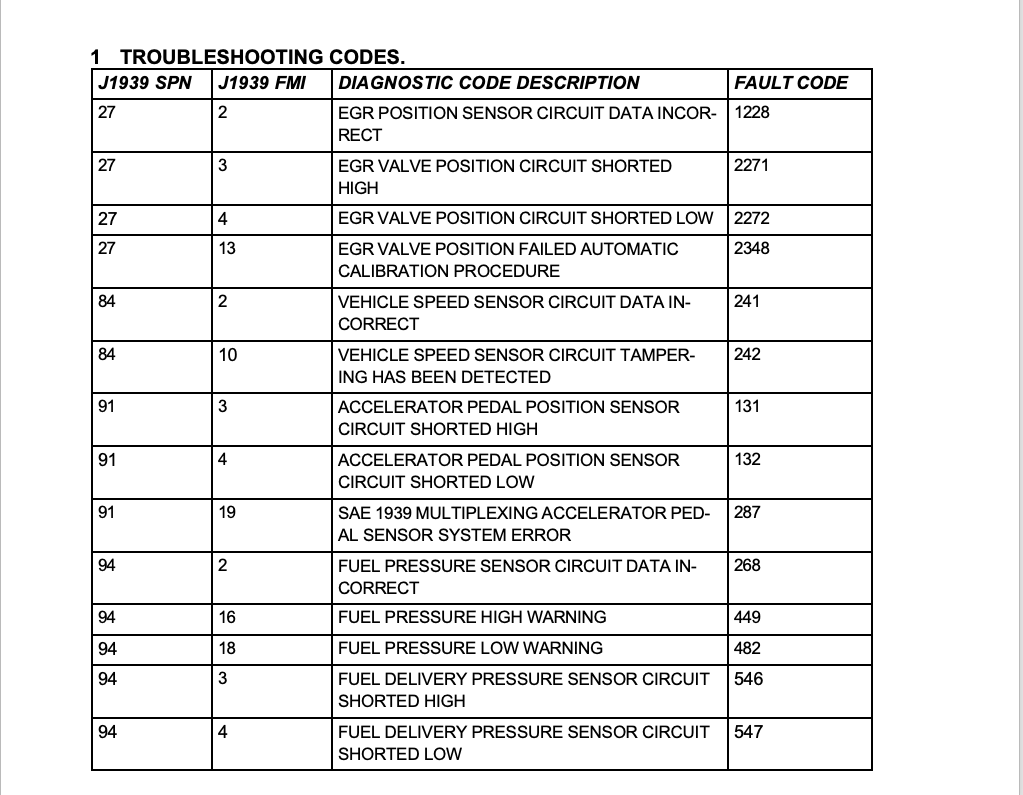
Click on the image above to download the full list!
Fault Codes That Cause Derate or Shutdown
A derate is a programmed reduction in engine power enforced by the ECM. Cummins uses derates to protect the engine and enforce emissions compliance. Understanding derate codes helps operators and fleet managers prioritize repairs correctly — and understand what happens if they don't.
| Code | Description | Derate Level | What Clears It |
|---|---|---|---|
| 6254 | SCR Operator Inducement | 25% Power Derate | Repair root cause and clear fault codes |
| 6255 | Engine Protection Derate | Variable (up to engine shutdown) | Repair root cause fault |
| 3712 | SCR Inducement Severity | Escalating Derate / 5 mph Limit | Repair DEF system and perform a forced regeneration |
| 4677 | DEF Tank Level Critically Low | 5 mph Derate | Refill DEF tank |
| 3868 | DEF Quality | Derate After Delay Period | Replace DEF and repair sensor if faulty |
| 6766 | DEF Property | Power Derate | Drain, flush, and refill DEF |
| 2962 | EGR Temperature | Engine Protection Derate | Repair EGR system |
| 1922 | DPF Pressure (Soot Load) | Derate if Forced Regeneration Fails | Perform a forced regeneration or service the DPF |
Derate escalation on Cummins engines: Many derate codes escalate over time if not repaired. A 25% power derate (code 6254) that goes unaddressed will escalate to a 5 mph speed derate, and eventually to a no-start condition. Address derate codes immediately to prevent escalation.
Fault Codes That Cause No-Start Conditions
These codes can prevent the engine from starting or cause it to shut down immediately after start-up.
| Code | Description | Why It Causes a No-Start Condition |
|---|---|---|
| 259 | Fuel Shutoff Valve Circuit Stuck Open | The engine cannot receive the fuel command needed to start and run. |
| 343 | ECM Internal Hardware Failure | The ECM cannot properly control engine functions required for startup. |
| 1117 | Power Supply Lost with Ignition On | The ECM loses power during cranking, preventing normal engine operation. |
| 426 | J1939 Datalink Failure | Loss of critical communication between engine control modules and sensors. |
| 284 | Crankshaft Position Sensor Supply Voltage Low | The ECM cannot accurately determine crankshaft position for fuel injection timing. |
| 778 | Secondary Engine Speed Sensor Error | A speed/position signal conflict prevents the ECM from validating engine timing. |
Technician Tip: When a Cummins cranks but won't start and you have no active codes, suspect power supply issues to the ECM — code 1117 may not log if the ECM loses power during cranking. Always verify ECM switched power and ground integrity as the first step on a no-start diagnosis before suspecting fuel or injection system components.
Aftertreatment Fault Codes Deep Dive (DEF / DPF / SCR / NOx)
Aftertreatment codes are the most frequently searched Cummins fault codes, driven by the complexity of EPA 2010+ emissions systems. The aftertreatment system includes the DPF (Diesel Particulate Filter), DOC (Diesel Oxidation Catalyst), DEF dosing system, SCR catalyst, and NOx sensors.
| Fault Code | Description | Severity | Most Common Cause | Typical Repair |
|---|---|---|---|---|
| 1922 | DPF Differential Pressure High (Soot Load) | High | DPF not regenerating | Perform a forced regeneration; if unsuccessful, service or replace the DPF |
| 3382 | EGR System Fault | High | Stuck EGR valve, clogged EGR cooler | Clean or replace the EGR valve and/or EGR cooler |
| 3712 | SCR Operator Inducement | High | DEF dosing failure | Test DEF injector and verify SCR catalyst efficiency |
| 3725 | Intake NOx Sensor Fault | High | Sensor failure, harness damage | Test sensor circuit and replace the sensor if confirmed faulty |
| 3868 | DEF Quality Fault | High | Diluted or incorrect DEF | Drain and refill DEF; test DEF quality sensor |
| 4572 | DEF Tank Temperature Fault | Moderate | Temperature sensor or heating element failure | Test DEF temperature sensor and heater circuit |
| 4677 | DEF Tank Level Low | Moderate | Low DEF fluid level | Refill DEF; test level sensor if tank is full |
| 5177 | VGT Actuator Software Fault | High | Actuator calibration error, carbon buildup | Recalibrate actuator; clean or replace VGT components as needed |
| 6254 | SCR Operator Inducement (Derate 25%) | High | DEF quality issue, NOx sensor fault | Verify DEF quality first, then inspect NOx sensors |
| 6766 | DEF Property Fault | High | DEF contamination | Drain, flush, and refill the DEF system with fresh certified DEF |
DPF Regeneration and Code 1922
Code 1922 indicates the DPF soot load has reached a level requiring intervention. When passive and active regenerations fail, soot accumulates to a critical level and triggers a derate.
Diagnostic sequence for Code 1922:
Record DPF soot load percentage from live data (typically 100% = forced regen threshold)
Attempt a stationary forced regeneration via Jaltest or INSITE
If forced regen fails or aborts, check DOC inlet temperature — if the DOC isn't reaching light-off temperature (~250°C), investigate DOC catalyst condition and EGR system health
If regen completes but code returns quickly: physical DPF inspection required (ash loading doesn't burn off — requires cleaning or replacement)
Technician Tip: Many shops replace the DPF when the real problem is a failed DOC not generating sufficient heat for regeneration, or an EGR system pushing excessive soot into the aftertreatment. Verify the complete regen system is functional before condemning the DPF. A DPF costs $1,500–$4,000. An EGR valve costs $200–$500.
Fuel System Fault Codes
| Fault Code | Description | Severity | Most Common Cause | Typical Repair |
|---|---|---|---|---|
| 486 | Injector Rail 1 Pressure Low — Warning | High | Clogged fuel filter, fuel supply issue | Replace fuel filters and test the fuel supply system |
| 559 | Injector Metering Rail 1 Pressure — High | High | Stuck pressure relief valve | Replace the pressure relief valve and verify rail pressure |
| 2313 | Fueling Actuator #2 Circuit Error | High | Actuator failure, wiring fault | Test wiring and replace the actuator if necessary |
| 2372 | Fuel Filter Restriction High | Moderate | Clogged fuel filter | Replace primary and secondary fuel filters |
Fuel Filter Restriction — Code 2372
Code 2372 is one of the most preventable fault codes. A clogged fuel filter starves the high-pressure pump of supply volume, leading to low rail pressure (code 486) and eventual engine protection events.
Severity: Moderate — but if ignored, leads to high-severity codes.
Diagnostic steps:
Replace primary and secondary fuel filters (do not skip secondary)
Monitor fuel filter restriction live data — should read below restriction threshold after replacement
If restriction returns quickly: inspect fuel tank for contamination (algae, water, debris)
Check fuel supply line for collapse or restriction
Sensor and Electrical Fault Codes
Sensor faults are among the most misdiagnosed Cummins codes. A sensor fault code does not confirm the sensor is faulty — it confirms the ECM is reading an out-of-range signal. The wiring between the ECM and the sensor must be verified before the sensor is condemned.
| Fault Code | Description | Severity | First Check |
|---|---|---|---|
| 212 | Engine Oil Temp Sensor — Shorted High | Moderate | Inspect sensor connector and wiring |
| 284 | EPS Sensor #1 Supply Voltage — Low | High | Check 5V supply circuit from ECM |
| 778 | Secondary Engine Speed Sensor Error | Moderate | Check air gap and sensor condition |
| 3361 | Intake Manifold Pressure — Out of Range | Moderate | Inspect MAP sensor circuit |
| 3725 | Aftertreatment NOx Sensor Fault | High | Check sensor harness and connector |
Standard sensor diagnostic process:
Verify sensor supply voltage at connector (typically 5V reference)
Verify ground return continuity from sensor back to ECM ground
Check signal wire for shorts to power or ground
Compare live data reading to expected value for current conditions
If circuit is verified good and reading is still incorrect: replace sensor
Technician Tip: On Cummins, the 5-volt reference circuit from the ECM is shared among multiple sensors. A short to ground on one sensor's signal wire can drag the 5V reference down and trigger apparent failures on multiple sensors simultaneously. If you have multiple sensor codes appear at the same time, suspect a short on one of the shared reference circuits before replacing multiple sensors.
ECM and Datalink Fault Codes
| Fault Code | Description | Severity | Action |
|---|---|---|---|
| 343 | ECM Internal Hardware Failure | Critical | Verify power and ground circuits before replacing ECM |
| 426 | J1939 Datalink Cannot Transmit | Critical | Inspect CAN bus wiring and termination resistors |
| 1117 | Power Supply Lost with Ignition On | Critical | Inspect ignition-switched power circuit |
How to Clear Cummins Fault Codes
Clearing fault codes on a Cummins engine requires a diagnostic tool with bidirectional capability. Disconnecting the battery does not permanently clear Cummins fault codes.
Method 1: Jaltest
Connect Jaltest interface to the vehicle diagnostic port
Select the Cummins engine system
Navigate to Fault Codes → Clear All Codes
Confirm the clear and verify codes are gone
Run engine through operating range and recheck
Method 2: Cummins INSITE
Connect INSITE laptop via RP1210 adapter
Select vehicle and connect to ECM
Navigate to the Fault Codes tab
Select codes to clear → Clear Selected or Clear All
Method 3: Key-cycle (limited)
Some inactive codes clear automatically after a set number of key cycles without the fault recurring. This does not work for active codes or derate codes.
Important — some codes require more than clearing:
DPF codes often require a successful forced regeneration before they'll clear
SCR inducement codes may require a DEF drain, refill, and system reset
Injector codes may require trim codes to be programmed after replacement
Check out these videos for additional Cummins training
Dealer Software vs. Jaltest Diagnostics
| Capability | Cummins INSITE | Jaltest Diagnostics |
|---|---|---|
| Fault Code Reading | ✓ Full | ✓ Full |
| OEM-Level Code Detail | ✓ Full | ✓ Full |
| Live Data Monitoring | ✓ | ✓ |
| Guided Troubleshooting | ✓ | ✓ |
| Wiring Diagrams | Via QuickServe | ✓ Integrated |
| Component Activation Tests | ✓ | ✓ |
| Forced DPF Regeneration | ✓ | ✓ |
| Injector Trim Coding | ✓ | ✓ |
| Multi-Brand Coverage | Cummins Only | 200+ Brands |
| Annual Software Updates | Subscription | 3× Per Year Included |
| Best Suited For | Cummins-Only Shops | Multi-Brand Fleets & Repair Shops |
The key difference: INSITE is Cummins-specific and provides the deepest OEM-level access for Cummins engines exclusively. Jaltest covers Cummins at an OEM-equivalent level and extends the same diagnostic depth to every other brand in your fleet — commercial, construction, agriculture, material handling, and marine — through a single interface and subscription.
Frequently Asked Questions
What is Cummins fault code 6255?
Code 6255 is the Engine Protection Derate code. It does not have its own root cause — it is always triggered by other active fault codes exceeding engine protection thresholds. Diagnosing 6255 means finding and repairing the root cause (typically coolant temperature, oil pressure, or aftertreatment system codes) that is causing the ECM to limit engine power.
Can I drive with a Cummins derate active?
You can drive short distances with a mild 25% power derate, but operating with a severe derate (5 mph limit or critical protection derate) risks further engine damage and regulatory violations. Derate codes are designed to compel immediate repair — continuing to operate typically escalates the derate level.
How do I reset a Cummins check engine light?
A Cummins check engine light will not reset by disconnecting the battery. You need a diagnostic scanner capable of communicating with the Cummins ECM — such as Jaltest or Cummins INSITE — to clear fault codes. The light will return if the underlying fault is not repaired before clearing.
What causes Cummins DEF fault codes?
The most common causes of DEF-related fault codes (3868, 4677, 6254, 6766) are: low DEF level, diluted or incorrect DEF fluid, failed DEF quality sensor, DEF dosing system failure, or NOx sensor malfunction. Start by checking DEF quality with a refractometer before replacing any components.
Does Cummins fault code 426 cause a no-start?
Code 426 (J1939 Datalink Cannot Transmit) can prevent engine starting if the ECM cannot communicate with modules required for operation. Verify CAN bus wiring integrity and check for 60Ω termination resistance across the bus before replacing any modules.
What is the difference between SPN and FMI on a Cummins?
SPN (Suspect Parameter Number) identifies the component — for example, SPN 3031 = DEF Tank Level. FMI (Failure Mode Identifier) describes how that component is failing — for example, FMI 1 = data below normal range. Together they pinpoint both the location and the type of fault.
What is the most common Cummins fault code?
In 2024–2026, DEF-related codes (6254, 3868, 4677) are the most frequently occurring Cummins fault codes in commercial truck applications. Code 2372 (fuel filter restriction) is the most common mechanical fault code.
Does Cummins fault code 343 mean I need a new ECM?
Not necessarily. Code 343 (ECM Internal Hardware Failure) should be diagnosed by first verifying ECM power supply quality, ground integrity, and connector condition. Poor voltage or ground connections cause a significant percentage of 343 codes in the field. Only condemn the ECM after electrical supply circuits are confirmed clean.
Can Jaltest clear Cummins derate codes?
Yes. Jaltest can clear Cummins derate codes including SCR inducement (6254, 3712) and engine protection codes (6255). However, some derate codes require the underlying fault to be repaired and specific procedures completed (such as a successful forced regeneration or DEF system reset) before the ECM will allow the code to clear permanently.
How long does it take to repair a Cummins fault code?
Repair time varies by fault. A DEF refill (code 4677) takes minutes. A forced DPF regen takes 30–60 minutes. An EGR cooler replacement typically requires 4–8 hours. An injector replacement is 2–4 hours per injector. ECM replacement with programming can take 4–8 hours.
In conclusion, Cummins fault codes are essential for diagnosing and fixing any problems quickly and efficiently. It’s important to become familiar with cummings fault codes, their meanings, and how to interpret Cummins fault code list reports in order to identify the root cause of any issue. Additionally, it is important to keep track of your Cummins engine's service history and follow a suggested maintenance schedule outlined by cummings in order to catch potential problems before they become serious issues. By following these best practices for maintaining your cummings engine in top condition, you can ensure that your vehicle runs smoothly at all times!
Looking for more personalized Cummins INSITE & QSOL training? Find out about our Cummins course, where we help expand technicians’ diagnostic skills and capabilities