Cylinder Cutout Test: What Your Results Actually Mean (And What To Do Next)
There is a moment in every diesel diagnosis where you either learn something useful or start chasing ghosts. The cylinder cutout test sits right at that fork in the road. Run it correctly, and it narrows an engine problem down fast. Misread the results, and you end up replacing injectors that were never the issue.
Most guides tell you how to run the test. This one tells you what the results actually mean — and what to do the moment you see a questionable or failed cylinder come up on screen.
What Is a Cylinder Cutout Test?
A cylinder cutout test (also known as a power balance test) is a diagnostic procedure where the ECM temporarily disables fuel delivery to one cylinder at a time while the engine is running. It then monitors how the engine responds—usually in terms of RPM drop and how much compensation is required from the remaining cylinders to maintain speed.
You’ll hear it called a few different things depending on the platform: power balance test, cylinder contribution test, cylinder balance test. Same idea across the board.
The goal is simple: isolate cylinder-level issues. Weak injector, poor compression, valve sealing problems, or anything affecting combustion efficiency will show up as an imbalance when that cylinder is removed from the equation.
Before You Run the Test: Two Things Most Technicians Skip
The Engine Must Be at Full Operating Temperature
Cold or partially warmed engines produce unreliable results. When coolant temperature is below operating range, the ECM is still in open-loop fueling. Fuel delivery is enriched. Combustion efficiency is inconsistent cylinder to cylinder. An injector that appears weak at 40°C might perform perfectly normally once the engine is fully up to temperature.
If you run a cylinder cutout test on a cold engine and see borderline results, you are essentially diagnosing the cold-start fueling strategy, not the engine. Get the truck on the road or let it idle for a full warm-up cycle before you start. No shortcuts here.
Do an Injector Leak-Down Test First
This is the step that gets skipped most often, and it causes more misread results than anything else on the list. If an injector has a leaking needle or control valve, it will bleed fuel into the cylinder even when commanded off. When you cut that injector during the cutout test, the cylinder does not go dead — fuel is still trickling in, maintaining partial combustion.
From the ECM's perspective, that cylinder still appears to be contributing something. The cutout result looks normal or mildly weak when the actual problem is significant. You walk away thinking the injector is fine. You're not. Run the leak-down test first, document the results, and then proceed with the cutout test so your data is clean.
How the Test Actually Works (Inside the ECM)
When the ECM cuts fuel to a single cylinder, it simultaneously increases fueling across the remaining cylinders to maintain target idle RPM. The amount of additional fueling required to compensate is the critical data point.
On platforms that expose fuel position or mm³ per stroke data — similar to what you'll see in Cat ET or Cummins INSITE — this compensation is sometimes described in terms of an "imaginary rack travel" value. The ECM is calculating how much additional fuel delivery is needed across active cylinders to recover the lost work from the disabled one. It's a derived value, not a physical measurement, but it gives you a relative picture of how much that cylinder was contributing.
Here’s the key:
If cutting a cylinder forces the ECM to add a lot of fuel elsewhere, that cylinder was doing real work.
If cutting a cylinder barely changes anything, it wasn’t contributing much to begin with.
Reading Your Results: What Pass, Fail, and "Questionable" Actually Mean
A Normal Result
When a healthy cylinder is cut, RPM should drop measurably and then stabilize as the ECM compensates. The engine feels the loss. On a six-cylinder at idle, you're removing roughly 16% of the engine's work contribution — that should produce a clear, repeatable RPM dip before recovery. If you are watching a live graph, you will see a sharp notch on the RPM trace for each healthy cylinder.
A "Questionable" or Borderline Result
A cylinder that shows as questionable is contributing, but not as much as it should. The RPM dip when that cylinder is cut is shallower than the others. The ECM compensation demand is lower.
Before you reach for a replacement injector, slow down. A questionable result on its own is not a purchase order. Start by verifying the injector trim files — if trim codes are mismatched or missing, the ECM may not be commanding the injector to the correct delivery volume. Check valve lash and injector adjustment; a marginally out-of-spec adjustment on a mechanical engine will produce a weak contribution without the injector being at fault. Then rerun the test.
A Clear Fail
Minimal or no RPM change when the cylinder is cut. The engine did not feel the loss because that cylinder was already not contributing meaningful work. At this point, your diagnosis is focused. You have one cylinder to investigate instead of six or twelve.
The next step is not to order an injector. The next step is to determine whether the injector is the problem or whether the cylinder itself has a mechanical issue. That distinction matters because replacing an injector into a cylinder with low compression or a leaking intake valve is a waste of parts.
When All Cylinders Pass But the Engine Still Runs Rough
Every cylinder shows a normal contribution, but the engine has a rough idle, vibration at cruise, or a complaint that brought it in the door. A few things to check:
Valve timing issues affecting multiple cylinders
Mechanical wear that’s evenly distributed (low overall compression)
Engine brake (Jake) interaction skewing results
Fuel quality or supply issues upstream
A passing cutout test doesn’t mean the engine is healthy. It just means no single cylinder is standing out.
Is It the Injector or the Cylinder?
Here is the diagnostic step that separates a careful technician from an expensive parts-replacer. When you have a clear fail or a consistent questionable on one cylinder, swap the suspect injector with a known-good adjacent cylinder and rerun the test.
Take cylinder 5 as an example. It shows a clear fail on the initial cutout test. You swap its injector with the injector from cylinder 6, which passed cleanly. You rerun the test. Two outcomes:
The problem moves to cylinder 6 → it’s the injector.
The problem stays on cylinder 5 → it’s the cylinder.
Skipping the swap test and replacing injectors based on a cutout result alone is one of the most common and expensive mistakes in diesel diagnostics. An injector for a modern common-rail engine is not a cheap component. The swap costs you twenty minutes. Skipping it can cost the customer several hundred dollars and another visit when the issue persists.
When compression or leak-down testing confirms a mechanical issue, escalate accordingly. Document everything: the initial cutout results, the post-swap results, the leak-down percentages. That documentation matters for warranty claims and customer conversations.
Cylinder Cutout Testing Across Different Applications
Commercial Trucks (Cummins, Detroit, PACCAR)
Most modern heavy-duty truck engines — Cummins ISX/X15, Detroit DD13/DD15, PACCAR MX — support automated cylinder cutout testing through their ECM via professional diagnostic software. The test is straightforward on these platforms; the tool commands the ECM, the ECM manages the fuel cut sequence, and results come back as RPM deviation data or a pass/questionable/fail grading depending on the platform.
On older mechanically injected engines, some diagnostic tools can still run a modified version of the test, though the ECM compensation data is less granular. In those cases, the technician relies more heavily on audible and feel-based RPM assessment alongside the tool data.
Construction and Off-Highway Equipment
Cutout testing on equipment engines — CAT, John Deere, Volvo CE, Komatsu — follows the same principles, though load conditions matter more. A wheel loader or excavator engine may have a different idle stability profile than an on-highway truck, and interpreting borderline results requires understanding how that specific engine manages fueling at low load.
On CAT engines using ADEM controllers, the ECM fuel position data during cutout can be especially informative. Deere's diagnostic interface through Service Advisor exposes similar information. The key is using a tool with genuine OEM-level coverage for the specific engine — generic OBD readers do not give you the depth of data needed to interpret these results correctly.
Marine Engines
Marine applications add a layer of complexity to the cylinder cutout test. Diesel engines in commercial vessels often run at constant load and RPM for extended periods, and temperature stabilization before the test is critical — particularly in colder water environments where engine bay temperatures can lag behind coolant temperature readings.
Interpreting results in a marine context also requires accounting for RPM and load conditions at sea. A result that looks borderline at dock idle may look completely different under working load. Some professional diagnostic platforms support marine engine diagnostics natively, including engines from Volvo Penta, Cummins Marine, and others, and allow technicians to capture and review data logged during actual operating conditions.
For marine applications, always document the test conditions — ambient temperature, coolant temp, load state — alongside the results. That documentation is valuable if the issue recurs and you need to compare test runs over time.
Common Mistakes When Interpreting Cylinder Cutout Results
Running the test on a cold engine is at the top of the list, followed by skipping the injector leak-down test beforehand. Both produce results that look real but are not reliable.
Treating a questionable result as a confirmed injector failure without further verification is costly. The borderline zone exists for a reason — it means investigate further, not replace now.
Not accounting for Jake brake or engine brake interaction is a specific trap on commercial trucks. If the compression brake is partially engaged or was recently used, results can be skewed on certain cylinders. Know the engine configuration before you interpret the data.
Replacing parts based on subtle, borderline RPM variations without further confirmation is how shops lose money and customer trust. A 20 RPM variation at idle on one cylinder is noise. A 150 RPM delta compared to the fleet average is a result. Know the difference for the specific engine you are working on, and use the swap test before committing to parts.
How Jaltest Makes the Cylinder Cutout Test More Reliable
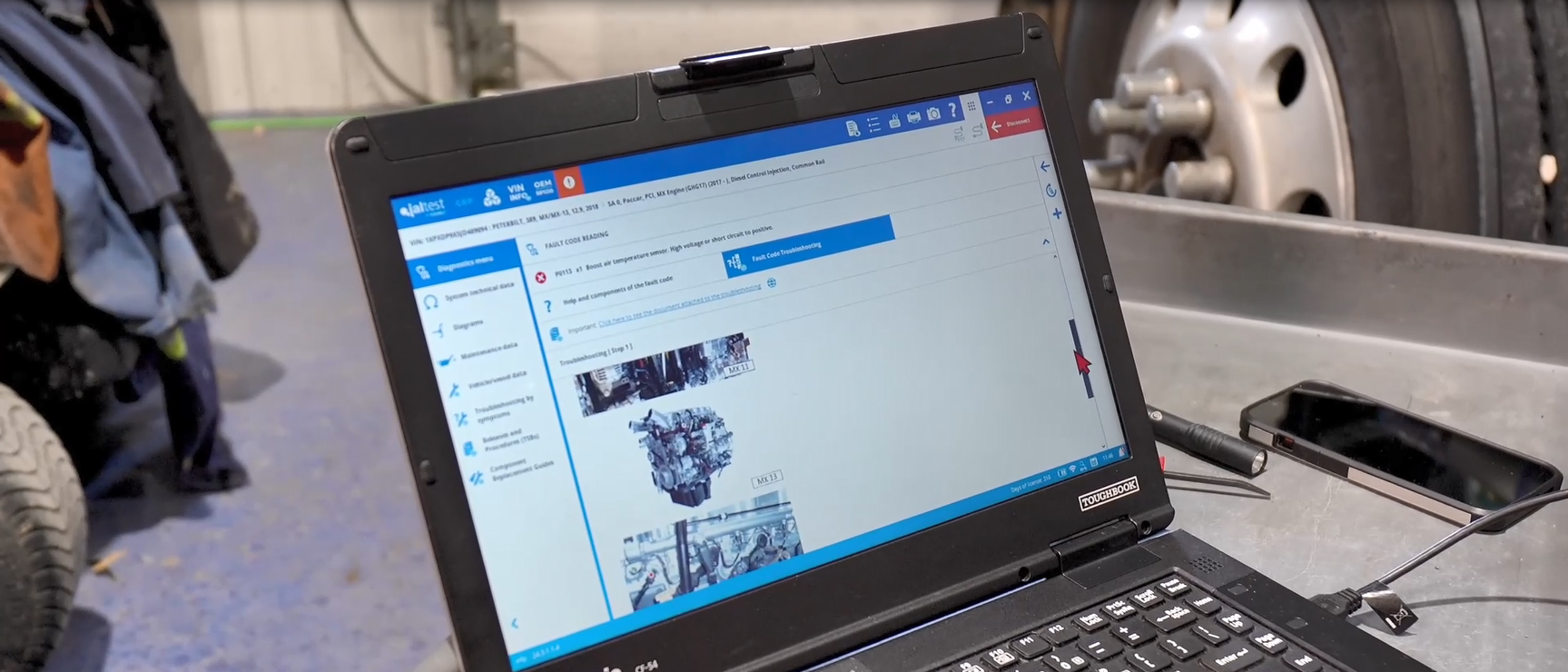
Manual cylinder cutout tests — where a technician manually disables each injector in sequence and listens for RPM changes — introduce timing variability and observer bias. What one technician hears as a borderline result, another hears as a pass. That subjectivity costs time.
Jaltest automates the entire cutout sequence, commanding the ECM through each cylinder in a consistent, repeatable way and displaying results as real-time graphed RPM traces. The difference between watching a live graph versus listening for audible RPM changes is significant — you can see the exact RPM deviation for each cylinder, compare it visually across the full engine, and catch subtle differences that are easy to miss by ear.
The multi-brand coverage is practical for mixed fleets and busy shops. A single Jaltest setup covers commercial vehicles, construction equipment, agriculture, and marine applications — Cummins and Volvo CE and Deere and Volvo Penta from the same toolset. That matters for fleet managers running mixed iron and for shops that service more than one equipment category.
Having graphed data also changes the conversation with customers and managers. You can show the results. A screenshot of the RPM trace with one cylinder clearly underperforming is more persuasive than a verbal report, and it creates a record for warranty or insurance purposes.
Want to see what Jaltest covers for your fleet? Download the Jaltest Pricing Guide to get a baseline.
Frequently Asked Questions
What does it mean when a cylinder fails a cutout test?
A failed cylinder produces minimal or no RPM change when fuel is cut to it — the engine did not feel the loss because the cylinder was already contributing little to no power. A clear fail narrows your diagnosis to one cylinder and prompts the next step: the injector swap test to determine whether the fault is the injector or a mechanical cylinder issue such as low compression or a valve problem.
What is the difference between a "questionable" and a "fail" result?
A questionable result means the cylinder is contributing less than it should, but it is not completely dead. The RPM dip when it is cut is shallower than healthy cylinders. A fail means the cylinder was not contributing meaningful work before the test started — cutting it causes almost no change. A questionable result warrants investigation (trim codes, valve adjustment, swap test) before any parts are ordered. A fail requires more aggressive follow-up.
Can a cylinder cutout test distinguish between an injector problem and a mechanical problem?
Not on its own, no. The cutout test tells you which cylinder is underperforming. It cannot tell you why. To distinguish between an injector fault and a mechanical issue like low compression, you need to perform the injector swap test: move the suspect injector to a known-good cylinder and rerun. If the problem follows the injector, it's the injector. If the problem stays with the original cylinder, investigate mechanical condition with a compression or leak-down test.
Why does the engine need to be at full operating temperature for the test?
Cold engines run in an enriched, open-loop fueling mode. Combustion efficiency varies across cylinders during warm-up in ways that are normal, not diagnostic. Running a cutout test below operating temperature will produce results that reflect cold-start fueling strategy rather than true cylinder performance. Always allow the engine to reach full operating temperature before running the test.
What is an injector leak-down test, and why should I do it before the cutout test?
An injector leak-down test measures how much fuel an injector allows to pass back through the return circuit — a proxy for internal injector wear and seal condition. A leaking injector bleeds fuel into the cylinder even when commanded off. If you run a cutout test on an engine with a leaking injector, that cylinder may appear normal because it is still receiving some fuel during the cut. Running the leak-down test first ensures your cutout data is not distorted by passive fuel delivery.
How is the cylinder cutout test performed on marine engines?
The same ECM-commanded sequence applies, but marine applications require extra attention to temperature stabilization and test conditions. Engines in vessels often run at steady loads, and dock-idle conditions may not reflect operating load. Interpret borderline results in the context of RPM and load at which the engine normally runs. Some professional diagnostic tools support marine engine platforms natively and can log data under working conditions for comparison.
Does the cylinder cutout test work on older mechanically injected diesel engines?
Partially. On mechanical engines, the ECM does not control individual injector timing in the same way. Some diagnostic tools can still command a modified cutout procedure, but the RPM compensation data is less granular. On fully mechanical engines, technicians often rely more on audible and tactile RPM assessment combined with tool data. Results are less precise and should be confirmed with compression testing.
When should I escalate from a cylinder cutout test to compression or leak-down testing?
Escalate when the injector swap test rules out the injector as the cause. If swapping the suspect injector to another cylinder does not move the fault, the problem is mechanical. Compression testing and cylinder leak-down testing will identify low compression, worn rings, stuck or burnt valves, and head gasket issues. Also escalate when all cylinders pass the cutout test but the engine still runs rough — that pattern points to mechanical or timing issues that the cutout test cannot isolate.