The Complete Caterpillar Fault Code List: Codes, Causes & Diagnostic Guide (2026 Update)
Caterpillar fault codes identify exactly which system is failing and how — but CAT uses its own code structure that differs from other manufacturers. CAT uses MID (Module Identifier), CID (Component Identifier), and FMI (Failure Mode Identifier) codes on older engines, and J1939 SPN/FMI codes on newer Tier 4 and Tier 4 Final engines. Knowing which system you're dealing with is the first step to an accurate diagnosis.
This guide covers the complete Caterpillar fault code list for C7, C9, C13, C15, C18, and 3500 series engines — including the most common codes with causes, symptoms, diagnostic steps, typical repairs, and severity levels. Whether you're a technician in the shop or a fleet manager trying to understand a warning light, this is the reference you need.
What Is a Caterpillar Fault Code?
A Caterpillar fault code is a diagnostic trouble code (DTC) generated by the ECM when it detects an out-of-range parameter. Older CAT engines use MID (Module Identifier) + CID (Component Identifier) + FMI (Failure Mode Identifier). Newer Tier 4 and Tier 4 Final engines use J1939 SPN/FMI codes alongside CAT-specific CDL (Cat Data Link) codes. CAT ET or Jaltest is required to read OEM-level codes.
Table of Contents
How to Read Caterpillar Fault Codes (MID, CID, FMI Explained)
Caterpillar uses two different fault code structures depending on engine age. Understanding which one you're looking at is the first step in any CAT diagnosis.
Older CAT Engines (Pre-Tier 4): MID + CID + FMI
Engines built before Tier 4 Final (roughly pre-2011 for most applications) use the CAT Data Link (CDL) system with three identifiers:
MID — Module Identifier Identifies which electronic control module generated the code.
| MID | Module / System |
|---|---|
| 36 | Engine ECM |
| 81 | Transmission ECM |
| 82 | Chassis ECM |
| 116 | Caterpillar Monitoring System |
| 140 | Implement ECM |
CID — Component Identifier Identifies the specific component or circuit reporting a fault. CID numbers are CAT-proprietary — they are not shared across other manufacturers.
Examples:
CID 0041 = 8-Volt DC Supply
CID 0091 = Throttle Position Sensor
CID 0110 = Engine Coolant Temperature Sensor
CID 0168 = System Voltage
CID 0190 = Engine Speed Sensor
CID 0248 = CAT Data Link
CID 0262 = 5-Volt Supply
FMI — Failure Mode Identifier Describes how the identified component is failing. FMI codes are standardized across manufacturers.’
| FMI | Meaning |
|---|---|
| 0 | Data valid, above normal operating range |
| 1 | Data valid, below normal operating range |
| 2 | Data erratic, intermittent, or incorrect |
| 3 | Voltage above normal (short to power) |
| 4 | Voltage below normal (short to ground) |
| 5 | Current below normal (open circuit) |
| 6 | Current above normal (grounded circuit) |
| 7 | Mechanical system not responding properly |
| 8 | Abnormal frequency, pulse width, or period |
| 9 | Abnormal update rate (communication fault) |
| 11 | Root cause not known |
| 12 | Bad intelligent device or component |
| 13 | Out of calibration |
| 14 | Special instructions |
Reading a CDL code: A fault displayed as MID 036 CID 0110 FMI 03 means the Engine ECM (036) has detected the Engine Coolant Temperature Sensor (0110) with voltage above normal (03) — a likely open circuit or short to supply on the sensor circuit.
Newer CAT Engines (Tier 4 / Tier 4 Final): J1939 SPN/FMI
Tier 4 and Tier 4 Final engines (post-2011) use J1939 SPN/FMI codes that are cross-manufacturer standardized, alongside CAT-specific CDL equivalents. You will often see both displayed simultaneously in diagnostic software.
SPN (Suspect Parameter Number): Identifies the component, standardized across J1939 manufacturers
FMI: Same failure mode identifiers as above
On Tier 4 Final engines (C13, C15, C18), you will also encounter Event Codes (prefixed with "E") which are not fault codes but condition-based alerts — for example, high coolant temperature or low oil pressure events that don't indicate a sensor or circuit failure but indicate an operating condition that needs attention.
Technician Tip: The biggest diagnostic mistake with CAT codes is confusing a CDL (CID-based) code with a J1939 (SPN-based) code. The numbers overlap — CID 0110 and SPN 110 both relate to coolant temperature, but they are different systems and require different diagnostic procedures. Always identify your engine tier and code type before looking up a fault.
Diagnostic Tools for Caterpillar Fault Code Analysis
Proper diagnosis of Caterpillar fault codes requires the use of specialized diagnostic tools. These tools enable technicians to access the engine's electronic control module (ECM) and retrieve fault codes, view live data, and perform other necessary functions.
Jaltest
By far, the best diagnostic tool for caterpillar fault codes is Jaltest Diagnostics. Jaltest is the leading provider of diagnostic and repair solutions for maintenance professionals. Jaltest's suite of products provides technicians with advanced diagnostics, automatic updates, troubleshooting guides, and more to help them quickly identify vehicle problems and get their customers back on the road. Jaltest’s intuitive interface makes it easy to use even for those without a lot of technical knowledge and its range of features helps reduce time spent diagnosing issues while increasing efficiency in the repair process. With Jaltest, mechanics can save time and money by streamlining their workflow.
For shops servicing mixed fleets that include CAT alongside other construction, agriculture, or commercial vehicle brands, Jaltest covers all of them under a single license — eliminating the need for multiple OEM-specific subscriptions.
Caterpillar Electronic Technician (CAT ET)
Caterpillar® Electronic Technician (Cat ET) is diagnostic software required to communicate, diagnose, and service electronically controlled Cat engines and machines. When connected to an Electronic Control Module (ECM), a technician has the ability to diagnose existing and potential problems, configure and calibrate the product, and obtain data for analysis.
CAT ET requires an RP1210-compliant communication adapter and an active SIS (Service Information System) subscription for access to wiring diagrams, troubleshooting guides, and calibration procedures.
The Complete Caterpillar Fault Code List
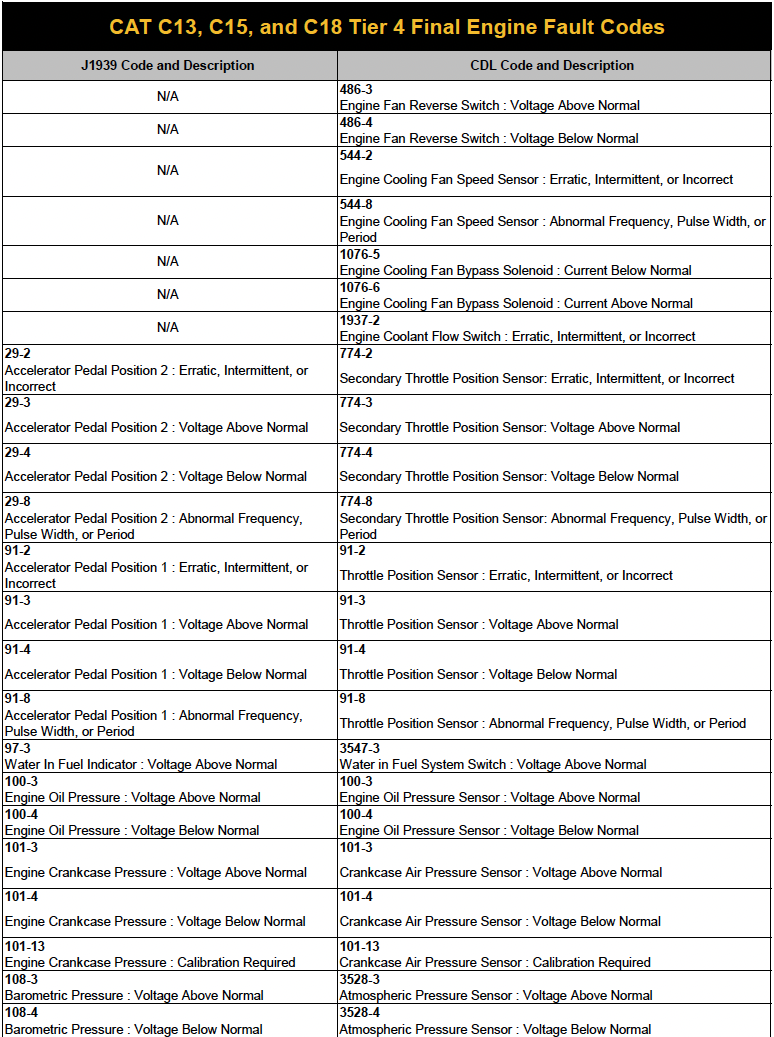
The downloadable PDF below covers fault codes for CAT C13, C15, and C18 Tier 4 Final engines, including both J1939 and CDL code formats. For the most common codes technicians encounter in the field — with causes, symptoms, and repair guidance — see the sections below.
Most Common Caterpillar Fault Codes (Top 10)
These are the codes technicians encounter most frequently across CAT C7, C9, C13, C15, C18, and 3500 series engines in construction, mining, and on-highway applications.
| Fault Code | Description | Severity | Most Common Cause | Typical Repair |
|---|---|---|---|---|
| E360 (High) | Engine Coolant Temperature — High | Critical | Low coolant, failed thermostat, water pump issue | Diagnose cooling system; do not operate until resolved |
| E361 (High) | Engine Coolant Temperature — Very High (Shutdown) | Critical | Severe cooling system failure | Engine shutdown required; perform full cooling system diagnosis |
| 110-0 | Engine Coolant Temp — Above Normal | High | Low coolant level, thermostat failure | Inspect cooling system, refill coolant, test thermostat |
| 110-3 | Engine Coolant Temp Sensor — Voltage High | Moderate | Open circuit, sensor failure | Check wiring; replace sensor if confirmed faulty |
| 174-3 | Engine Fuel Temperature — Voltage Above Normal | Moderate | Open circuit in sensor wiring | Inspect harness and replace sensor if necessary |
| 190-8 | Engine Speed — Abnormal Frequency | High | Speed sensor air gap, sensor failure, tone ring damage | Check sensor gap; test speed sensor and tone ring |
| 2458-2 | DPF #1 Differential Pressure — Erratic | High | Plugged pressure ports, failing sensor | Clean pressure ports; test sensor; verify DPF soot load |
| 41-3 | 8-Volt DC Supply — Voltage Above Normal | High | Short to power on 8V reference circuit | Inspect sensors sharing the 8V supply and isolate fault |
| 41-4 | 8-Volt DC Supply — Voltage Below Normal | High | Short to ground on 8V reference circuit | Disconnect sensors one at a time to locate short |
| 2348-9 | SAE J1939 Data Link #2 — Abnormal Update Rate | Critical | CAN bus wiring damage, termination fault | Check CAN wiring and measure termination resistance |
Code 110-0 / E360 — Engine Coolant Temperature High
What it means: The ECM has detected engine coolant temperature above the normal operating threshold. Code 110-0 is a fault code (sensor-based). Event code E360 is a condition-based alert that the actual coolant temperature is dangerously high.
Severity: Critical | Can I keep operating? No. Continued operation risks catastrophic engine damage.
Common causes:
Low coolant level (leak, boilover)
Failed or stuck-closed thermostat
Water pump failure or slipping belt
Blocked radiator or cooler cores
Head gasket failure (combustion gases entering coolant)
Symptoms: High temperature gauge reading, coolant temperature warning on display, white steam from hood, possible engine shutdown (E361 / very high temperature event).
Diagnostic steps:
Check coolant level immediately — do not open radiator cap on a hot engine
Inspect for external coolant leaks (hoses, radiator, water pump)
Verify cooling fan operation and fan drive engagement
Check thermostat function (replace if stuck closed)
Pressure test cooling system for internal leaks
Monitor coolant temperature with live data via Jaltest or CAT ET
Typical repair: Thermostat replacement ($50–$200). Water pump ($400–$1,200). Radiator cleaning or replacement ($300–$1,500). Head gasket (significant cost — avoid by addressing overheating immediately).
Technician Tip: CAT engines running the ACERT system (C13, C15) have an EGR cooler that also passes coolant. A failed EGR cooler can cause coolant loss into the exhaust or oil without obvious external leaks. If a cooling system pressure test passes clean but coolant level keeps dropping, inspect the EGR cooler.
Code 190-8 — Engine Speed Sensor Abnormal Frequency
What it means: The ECM is receiving an abnormal signal from the primary engine speed/timing sensor — the signal frequency, pulse width, or period is outside the expected range.
Severity: High | Can I keep operating? No. Loss of speed signal causes rough running, loss of power, or no-start.
Common causes:
Incorrect air gap between sensor tip and tone ring (most common)
Damaged sensor (cracked housing, corroded connector)
Damaged tone ring (broken tooth, corrosion)
Wiring damage (chafed, shorted, or open signal wire)
Secondary speed sensor conflict (dual-sensor engines)
Diagnostic steps:
Inspect sensor connector for corrosion or pushed-back pins
Check sensor air gap — spec varies by engine but typically 0.5–1.5mm; use a feeler gauge
Inspect tone ring for damaged or missing teeth
Monitor speed sensor signal with live data — look for drop-outs or erratic readings at cranking speed
If signal is clean at idle but drops at load: suspect intermittent wiring
Typical repair: Sensor replacement ($80–$250). Air gap adjustment (no parts cost). Tone ring replacement ($200–$500 plus labor).
Technician Tip: Many technicians replace the speed sensor immediately when code 190-8 appears. In reality, the most common cause is an air gap that has changed due to wear on the tone ring surface or sensor tip erosion. Check the gap with a feeler gauge before ordering parts.
Code 41-3 and 41-4 — 8-Volt DC Supply Fault
What it means: The ECM's internal 8-volt reference supply — which powers multiple sensors — is reading above normal (41-3) or below normal (41-4).
Severity: High | Can I keep operating? No. An 8V reference fault will cause multiple sensor faults to appear simultaneously.
Important: This code almost always triggers multiple other sensor codes at the same time because multiple sensors share the 8V supply. Do not attempt to diagnose the individual sensor codes until the 8V supply issue is resolved.
Common causes for 41-4 (voltage below normal):
Short to ground on one of the sensors connected to the 8V supply
Wiring damage on the 8V reference circuit
ECM internal supply failure (less common)
Common causes for 41-3 (voltage above normal):
Short to a higher voltage source on the 8V reference wire
ECM internal supply fault
Diagnostic steps for 41-4 (most common):
Identify all sensors powered by the 8V reference (refer to wiring diagram)
Disconnect sensors one at a time and monitor 8V supply voltage with live data
When voltage returns to normal after disconnecting a sensor: that sensor or its wiring is shorted
Inspect the identified sensor's wiring harness at known chafe points before replacing the sensor
Technician Tip: When you see code 41-3 or 41-4 alongside five or six other sensor codes, the other codes are not independent faults — they're all a consequence of the 8V supply fault. Fix the 8V supply issue first. Every other code will clear. Technicians who diagnose each sensor code individually waste significant diagnostic time and replace parts unnecessarily.
Code 2458-2 — DPF Differential Pressure Sensor Erratic
What it means: The DPF #1 differential pressure sensor is providing an erratic, intermittent, or incorrect signal. This sensor measures the pressure drop across the DPF to estimate soot load.
Severity: High | Can I keep operating? The engine may continue operating but DPF soot load monitoring is compromised. Risk of DPF damage from undetected overloading.
Common causes:
Plugged or damaged pressure sampling ports/hoses (most common — not a sensor failure)
Failing differential pressure sensor
Sensor connector corrosion
Damaged signal wiring
Diagnostic steps:
Inspect both pressure sampling hoses/tubes for cracks, kinks, or blockages — plugged ports are the #1 cause
Compare DPF differential pressure to expected value for current soot load and exhaust flow
With engine running, disconnect one port at a time — pressure should drop or read zero
If ports are clear, inspect connector and measure sensor supply voltage and signal
Confirm with a known-good sensor or use a reference manometer
Typical repair: Clear blocked pressure ports (no parts cost). Sensor replacement ($150–$400).
Technician Tip: On CAT C13/C15/C18 engines, the DPF pressure ports run along the exhaust system and are prone to soot plugging, especially on machines with a lot of idle time or short-cycle operation. Clean the ports before replacing the sensor — this resolves the majority of 2458-2 codes without any parts cost.
Code 2348-9 — J1939 Data Link #2 Abnormal Update Rate
What it means: The J1939 CAN bus #2 data link has stopped updating at the expected rate — the ECM is not receiving data from one or more modules on this network.
Severity: Critical | Can I keep operating? No. Loss of CAN bus communication affects multiple control systems.
Common causes:
Damaged CAN bus wiring (chafed, cut, corroded)
Missing or failed termination resistor (spec: 60Ω across CAN H and CAN L)
Failed module pulling the bus low
Connector corrosion at a CAN junction
Diagnostic steps:
Measure resistance between CAN H and CAN L with all power off (spec: 60Ω = two 120Ω termination resistors in parallel)
If resistance is not 60Ω: locate and test each termination resistor individually
Inspect CAN wiring harness at known wear and chafe locations
If wiring and termination are good: disconnect modules one at a time to isolate a failed module pulling the bus down
Caterpillar Fault Codes That Cause Derate or Shutdown
Caterpillar engines implement staged derates and shutdowns through a combination of fault codes (hardware/sensor failures) and event codes (operating condition alerts). Understanding which codes trigger power reduction prevents surprises in the field.
| Code | Description | Derate / Action | What Clears It |
|---|---|---|---|
| E360 High | Coolant Temperature High | Derate | Repair cooling system |
| E361 High | Coolant Temperature Very High | Shutdown | Allow cooldown; repair cooling system |
| E362 High | Engine Oil Pressure Low | Shutdown | Diagnose oil pressure system |
| E539 High | Intake Manifold Temperature Very High | Derate | Diagnose charge air cooling system |
| 2458-2 | DPF Differential Pressure Erratic | Derate (soot management) | Clean pressure ports; test sensor; check DPF soot load |
| 3714 Series | SCR / DEF System Fault (Tier 4 Final) | Derate | Perform DEF system diagnosis |
| 110-0 | Coolant Temperature Above Normal | Derate Warning | Cooling system repair |
| 100-1 | Engine Oil Pressure Below Normal | Derate / Shutdown | Diagnose oil system |
Note on Event Codes vs. Fault Codes: CAT uses Event Codes (prefixed "E") to indicate operating conditions that trigger protection responses. Event Code E360/E361 (high coolant temp) triggers shutdown regardless of whether the coolant temperature sensor has a fault code. Both must be understood to correctly diagnose a derate event.
Caterpillar Fault Codes That Cause No-Start Conditions
| Code | Description | Why It Causes No-Start |
|---|---|---|
| 190-8 | Engine Speed Sensor — Abnormal Frequency | ECM cannot determine crankshaft position for injection timing |
| 342-8 | Secondary Engine Speed Sensor | Speed/position signal conflict prevents fuel delivery |
| 41-4 | 8V DC Supply — Voltage Below Normal | Multiple sensors lose reference voltage, disabling fuel command |
| 168-1 | System Voltage Below Normal | Insufficient power supply to ECM during crank/start |
| 168-4 | System Voltage — Short to Ground | ECM power supply fault preventing normal startup |
| 2348-9 | J1939 Data Link #2 — Abnormal Update Rate | Loss of communication between modules required for engine start authorization |
| 1679-5 | Fuel Pump Relay — Current Below Normal | Fuel pump not activated, preventing fuel delivery to engine |
Technician Tip: On CAT engines, when the machine cranks but won't start and you have no active codes (or can't connect your scanner), suspect the J1939 data link before anything else. If the CAN bus is down, your scanner may not connect, and the engine won't start due to loss of communication. Verify CAN bus termination resistance (should be 60Ω) as an offline check that requires no running communication.
Aftertreatment Fault Codes — Tier 4 and Tier 4 Final Engines (C13, C15, C18)
CAT Tier 4 Final engines use a combined DPF + SCR aftertreatment system with DEF (Diesel Exhaust Fluid). These codes are the most commonly searched CAT fault codes for post-2011 machines.
| Fault Code | Description | Severity | Most Common Cause | Typical Repair |
|---|---|---|---|---|
| 2458-2 | DPF #1 Differential Pressure — Erratic | High | Blocked pressure ports | Clean pressure ports; replace sensor if confirmed faulty |
| 3714-0 | SCR Operator Inducement — Derate | High | DEF quality issue, NOx sensor fault | Check DEF quality first |
| 3720-3 | DEF Dosing Unit — Voltage Above Normal | High | Wiring short to power | Inspect dosing unit harness and wiring |
| 3251-0 | DPF Soot Loading — High | High | DPF not regenerating | Perform forced regeneration; check DOC inlet temperature |
| 3216-2 | Outlet NOx Sensor — Erratic | High | Sensor failure, harness damage | Test sensor circuit and wiring |
| 3226-2 | Inlet NOx Sensor — Erratic | High | Sensor failure, contamination | Test sensor; replace if confirmed faulty |
| 5298-0 | DEF Tank Level — Low | Moderate | Low DEF fluid | Refill DEF tank |
| 3031-1 | DEF Tank Level — Below Normal | Moderate | Low or failed level sensor | Refill DEF; test level sensor |
Forced Regeneration on CAT Tier 4 Final Engines
When code 3251-0 (DPF high soot load) is active and the engine cannot complete an automatic regeneration, a stationary forced regeneration must be performed using CAT ET or Jaltest.
Before attempting a forced regen:
Verify DOC inlet temperature capability — if the DOC can't reach light-off temperature, the regen will abort
Check EGR system operation — excessive EGR soot loading reduces regen effectiveness
Ensure fuel level is adequate — regens consume significant fuel
Position the machine away from combustible materials (exhaust temperatures exceed 600°C during regen)
How to Clear Caterpillar Fault Codes
Caterpillar fault codes require a diagnostic tool to clear — they cannot be reset by disconnecting the battery.
Method 1: Jaltest
Connect Jaltest interface to the machine's diagnostic port
Select Caterpillar and the appropriate system (engine, transmission, etc.)
Navigate to Fault Codes → Clear All Codes (or select specific codes)
Confirm the clear and verify codes are gone
Run machine through operating conditions that triggered the original fault and recheck
Method 2: CAT ET (Electronic Technician)
Connect via RP1210-compatible adapter
Select the ECM to communicate with
Navigate to Diagnostics → Diagnostic Codes
Select codes and choose Clear
Method 3: Flash code reset (older CDL engines only)
On older engines equipped with a diagnostic lamp (not applicable to all machines), some codes can be cleared by performing a specific key-switch cycle sequence. Refer to the operator's manual for the specific procedure for your machine.
Codes that may not clear until the repair is complete:
DPF soot load codes may require a successful forced regeneration
Calibration codes (FMI 13) require the calibration procedure to be completed
Event codes may require operating conditions to normalize before clearing
CAT ET vs. Jaltest: Which Tool Do You Need?
| Capability | CAT ET (Electronic Technician) | Jaltest |
|---|---|---|
| Fault Code Reading (CDL + J1939) | ✓ Full | ✓ Full |
| Event Code Reading | ✓ Full | ✓ Full |
| Live Data Monitoring | ✓ | ✓ |
| Guided Troubleshooting | Via SIS | ✓ Integrated |
| Wiring Diagrams | Via SIS Subscription | ✓ Integrated |
| Component Activation Tests | ✓ | ✓ |
| Forced DPF Regeneration | ✓ | ✓ |
| ECM Programming / Flash | ✓ Full | Limited |
| Multi-Brand Coverage | CAT Only | 200+ Brands |
| SIS Subscription Required | Yes (Additional Cost) | No |
| Best Suited For | CAT-Only Dealers and Shops | Mixed-Fleet Shops and Contractors |
The bottom line: CAT ET with a full SIS subscription is the deepest tool for CAT-only work, especially for ECM programming and flashing. Jaltest covers CAT at an OEM-equivalent diagnostic level and extends that capability to every other brand in a mixed fleet — making it the better choice for contractors, rental yards, and shops that service multiple equipment brands.
Need Help Diagnosing a CAT Fault Code?
When a fault code comes up and you need more than a definition, what you actually need is the ability to read codes, view live data, access wiring diagrams, run component tests, perform calibrations, and follow guided troubleshooting steps specific to the fault and machine. Jaltest provides all of these capabilities for Caterpillar engines — C7, C9, C13, C15, C18, 3500 series, and CAT construction equipment — alongside coverage for every other brand in your fleet through a single platform and subscription.
Request a Jaltest Demo → Start a Free Trial → View CAT Coverage →
Looking for more training and tutorials? Check out our Youtube channel.
Frequently Asked Questions
How do I read a CAT error code?
Connect a diagnostic tool — Jaltest or CAT ET — to the machine's service port. The tool will display all active and inactive fault codes with MID, CID, and FMI (older engines) or SPN and FMI (Tier 4 engines). Each code identifies the module, the component, and the type of failure. Without a scanner, older machines can display flash codes through the diagnostic lamp, but this method doesn't provide FMI data.
How can I check a Caterpillar fault code without a code reader?
On older CDL-equipped CAT machines, you can initiate a flash code display by turning the key to the ON position and locating the diagnostic connector in the fuse panel. Unplugging the termination plug from the diagnostic connector starts the flash code sequence — the service lamp flashes the MID and CID in sequence. Note that this method only works on machines with a service lamp and does not provide FMI (failure mode) data, limiting its usefulness for accurate diagnosis.
What is the difference between MID, CID, and FMI on a CAT?
MID (Module Identifier) identifies which ECM generated the code. CID (Component Identifier) identifies the specific component that has a fault — these are CAT-proprietary numbers. FMI (Failure Mode Identifier) describes how the component is failing (voltage high, voltage low, open circuit, etc.). All three together form a complete CAT CDL fault code on older engines.
What is the difference between a CAT fault code and an event code?
A fault code indicates a hardware failure — a sensor reading out of range, a circuit fault, or an actuator not responding. An event code (prefixed "E") indicates an operating condition exceeded a threshold — such as high coolant temperature or low oil pressure. Both can trigger derates and shutdowns but are diagnosed differently. Event codes require you to investigate why the condition occurred, not just which component has a bad signal.
Can I drive or operate a CAT machine with active fault codes?
It depends on the code severity. Informational and low-severity codes may allow continued operation. High-severity codes and event codes (especially oil pressure, coolant temperature, and emissions system codes) should prompt immediate investigation. Critical codes — especially those triggering engine protection derates or shutdowns — mean stop operating immediately and diagnose before continuing.
What causes Caterpillar code 41-3 or 41-4?
Codes 41-3 and 41-4 indicate a fault in the ECM's 8-volt reference supply circuit that powers multiple sensors. Code 41-4 (voltage below normal) is almost always caused by a short to ground on one sensor's signal wire loading down the shared reference circuit. Code 41-3 (voltage above normal) is less common and typically indicates a short to a higher-voltage source. These codes will generate multiple simultaneous sensor codes — diagnose the 8V supply fault first before addressing individual sensor codes.
What does CAT fault code 190-8 mean?
Code 190-8 means the Engine Speed Sensor is generating an abnormal frequency, pulse width, or period. The most common causes are an incorrect air gap between the sensor tip and the tone ring, a damaged tone ring tooth, or sensor connector corrosion. Check the air gap with a feeler gauge before replacing the sensor — incorrect gap is responsible for the majority of 190-8 codes.
Does Jaltest work on Caterpillar construction equipment?
Yes. Jaltest covers Caterpillar engines and machines including construction equipment (excavators, wheel loaders, graders, dozers) across CAT's major engine families: C4.4, C6.6, C7, C9, C13, C15, C18, and 3500 series. Jaltest provides fault codes, live data, guided troubleshooting, wiring diagrams, and component tests for CAT equipment at an OEM-equivalent level.
How do I perform a forced DPF regeneration on a CAT C13, C15, or C18?
A stationary forced regeneration on CAT Tier 4 Final engines requires either CAT ET or a capable third-party tool like Jaltest. Position the machine away from combustibles, verify adequate fuel level, confirm the DOC inlet temperature capability, then initiate the forced regen through the Aftertreatment section of the diagnostic software. The process typically takes 20–45 minutes. If the regen aborts, check DOC inlet temperature and EGR system before retrying.
What does code 2458-2 mean on a CAT C13/C15/C18?
Code 2458-2 means the DPF differential pressure sensor is reading an erratic, intermittent, or incorrect signal. Before replacing the sensor, inspect both pressure sampling ports and hoses — they commonly become blocked with soot on engines with significant idle time. Clear the ports and retest. If the signal is still erratic with clean ports and an intact wiring harness, replace the sensor.